Musical review: Sarah Hyland and Skylar Astin are perfectly cast in the West End’s Cabaret
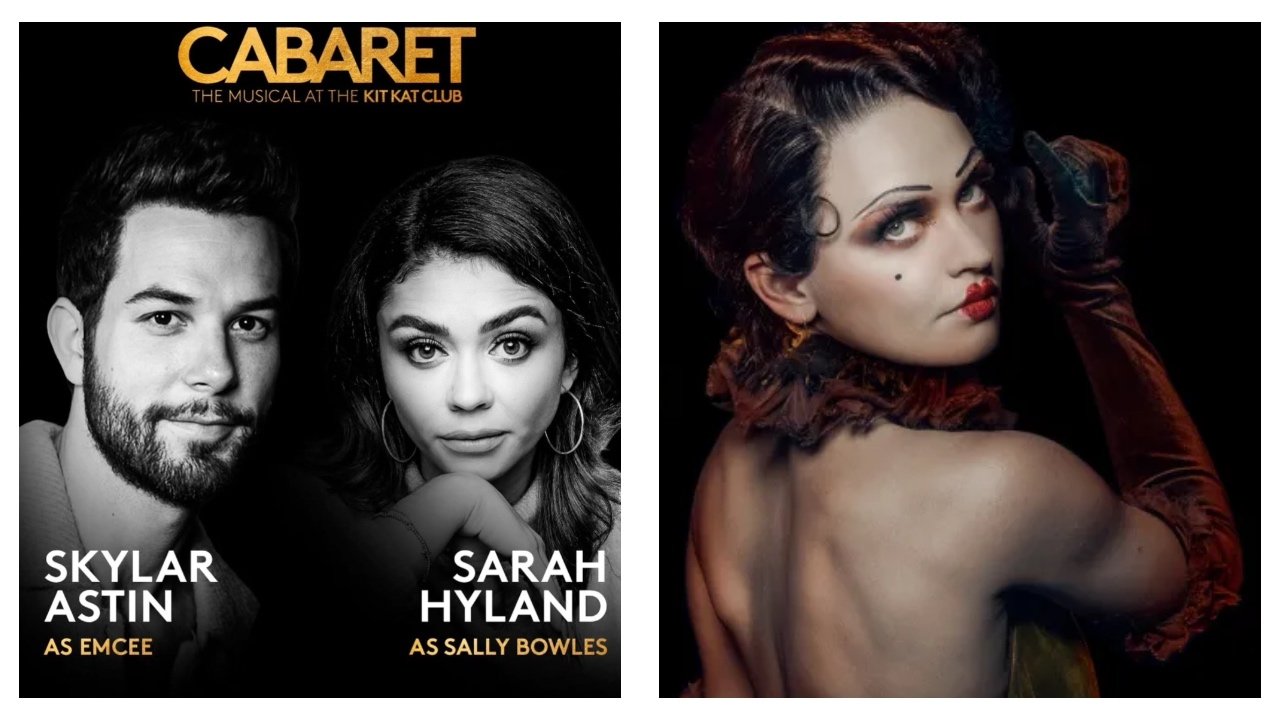
There are some shows where you take your seat, the lights go down and the performance begins.
Cabaret at the Kit Kat Club is not one of those shows.
From the moment you enter the transformed Playhouse Theatre in London’s West End, the performance has already started, writes Music News Blitz’s Anna Ferraz.
Welcome to the Kit Kat Club
The outside world gradually disappears as you descend into the Kit Kat Club, surrounded by performers, musicians and dancers who occupy the venue before you have even reached the auditorium.
It is less like walking into a theatre and more like entering another reality.
That immersive atmosphere was one of the things that immediately blew me away. Members of the Prologue Company perform throughout the building before the main show and return during the interval, meaning the world of Cabaret never really switches off.
Even when you aren’t sitting in front of the stage, there is something happening around you.
The result is an experience where, for a few hours, you genuinely feel disconnected from real life.
And then Sarah Hyland and Skylar Astin arrive.
Sarah Hyland delivers a stunning Sally Bowles
Hyland, best known to many audiences as Haley Dunphy in Modern Family, takes on Sally Bowles following her Broadway run in The Great Gatsby.
This marks her West End debut, and she could hardly have chosen a more emotionally demanding role.
Her Sally is energetic, funny and captivating, but underneath that outward confidence is an increasing sense of vulnerability.
Hyland impressed me throughout the show, but her performance of “Cabaret” was the moment that completely blew me away.
It is one of musical theatre’s most recognisable songs, but in this production it doesn't simply function as a big title number.
Hyland turns it into something raw, emotionally exposed and increasingly devastating.
Her vocal performance is powerful, but it is her acting through the song that makes it unforgettable.
There is pain, desperation and defiance behind the words, with Hyland seeming to fight against everything Sally refuses to confront.
Every expression and movement adds another layer to the performance.
By the final stretch of the song, I wasn't simply listening to Hyland sing “Cabaret”; I was watching Sally Bowles painfully unravel in front of me.
It was breathtaking.
Hyland was the perfect casting for the role.
Skylar Astin commands the club
Opposite her is Skylar Astin as the Emcee, another piece of casting that feels completely right.
Astin is probably most widely recognised from Pitch Perfect, while his theatre background stretches back to the original Broadway production of Spring Awakening.
Here, he gets a role that allows him to be playful, theatrical and deeply unsettling sometimes within the space of the same scene.
The Emcee initially appears to be our charismatic guide to the Kit Kat Club.
Astin has the comic timing and stage presence needed to make those early sequences enormously entertaining, effortlessly commanding the room.
But Cabaret slowly changes around him.
As the political reality outside the club becomes impossible to ignore, the Emcee becomes darker and more disturbing.
Astin handles that tonal shift brilliantly.
What starts as mischievous entertainment gradually develops an uncomfortable edge, and his performance helps connect the fantasy of the Kit Kat Club with the increasingly frightening world surrounding it.
Like Hyland, Astin feels perfectly cast to me.
An ensemble without a weak link
The strength of the production extends far beyond its two new stars.
Baker Mukasa plays American writer Clifford Bradshaw, whose arrival in Berlin draws him into Sally's world, while West End veteran Ruthie Henshall plays Fraulein Schneider and Robert Hands takes the role of Herr Schultz.
The new company also features Ronan Burns as Ernst Ludwig and Lindsay Atherton as Fraulein Kost/Fritzie.
The relationship between Schneider and Schultz provides some of the production’s most tender moments, while also becoming increasingly painful as the political climate around them changes.
That is ultimately what makes Cabaret such an intense experience.
The show can be wildly entertaining.
It can be funny, provocative and spectacular.
Yet underneath all of that entertainment is a storyline becoming progressively darker.
The Kit Kat Club initially feels like an escape from reality.
Outside it, however, Berlin is changing as Nazism rises around these characters.
Eventually, fantasy and reality can no longer remain separate.
The contrast is chilling.
MORE MUSIC NEWS: Taylor Swift announces new single ‘Patient Zero’ and four-song Life of a Showgirl encore

A theatre transformed
Director Rebecca Frecknall’s production doesn't simply stage Cabaret inside the Playhouse Theatre.
The building itself has been reimagined as the Kit Kat Club.
Designer Tom Scutt has transformed the venue, including the auditorium, bars and performance spaces, while the traditional relationship between audience and stage has been disrupted.
The production surrounds its circular stage with spectators, creating an intimacy that makes the performances feel remarkably close.
That transformation is crucial to the experience.
Phone cameras are covered with stickers, meaning there is no taking photos or recording videos of the stage or performances.
In an age where almost every live experience ends up being viewed through somebody's phone screen, it makes a noticeable difference.
Everyone is encouraged to be present in the moment, while the secrecy also preserves the experience for audiences who haven't yet stepped inside.
Shows in-between shows
Arriving early is therefore genuinely part of seeing the show.
The pre-show performances are not just something to pass the time before curtain-up; they establish the strange, seductive atmosphere of the club before the main story begins.
The performers appearing again during the interval also keeps that illusion alive.
You never completely return to an ordinary West End theatre until you leave the building.

An intense first act gives way to a darker finale
The evening is substantial. The first act runs for roughly one hour and 40 minutes, while the second is considerably shorter at around 45 minutes.
With the interval included, the production's official running time is approximately two hours and 45 minutes.
That long first act gives the story room to establish its characters, relationships and the intoxicating atmosphere of Berlin nightlife before everything begins to fracture.
The second act feels different. Shorter, darker and increasingly uncomfortable, it strips away much of the escapism that defined the beginning of the evening.
That contrast makes the final stages incredibly powerful.
Hyland and Astin begin a new Cabaret chapter
Hyland and Astin officially began their runs as Sally Bowles and the Emcee on September 21, 2026, with the production marking the West End debut for both performers.
Hyland is currently scheduled to remain with the show through January 23, 2027, while Astin's run as the Emcee is scheduled through December 12, 2026.
They join a production that has become one of the West End's most distinctive theatrical experiences since opening at the transformed Playhouse Theatre in 2021.
Rebecca Frecknall directs the production, with Tom Scutt responsible for its striking set and costume design.
An immersive West End experience
What stayed with me most after seeing Cabaret was just how complete the experience feels.
This isn't simply a case of two recognisable actors joining an established West End musical.
Hyland and Astin both disappear into their roles, supported by casting across the company that feels exceptionally well judged.
Astin is magnetic as the Emcee. Hyland is outstanding as Sally Bowles, but the production surrounding them is equally important.
From the performers greeting audiences inside the Kit Kat Club before the show to the intimacy of the auditorium and the increasingly disturbing story unfolding onstage, Cabaret manages to be intensely entertaining while never losing sight of the darkness underneath its spectacle.
For a few hours, it doesn't feel like you're sitting in a theatre in London.
You are inside the world of the Kit Kat Club, enjoying a drink with Sally, Emcee, Clifford and Fritzie.
And now with Hyland and Astin at its centre, this new chapter of Cabaret feels like one hell of a night out.
READ NEXT: Music analysis: Jhené Aiko denies new song is about Big Sean amid fan speculation